

A Thin Veneer
Our proximity to anarchy

“Every society is three meals away from chaos”
― Vladimir Lenin
“A city's only ever three hot meals away from anarchy.”
― Alastair Reynolds, Terminal World
A thin veneer. That is all our supposedly civilised society is. With our electronic gadgets, our cars, our simulacrum of democracy which consists largely of putting a cross on a piece of paper every five years, our marble-paved shopping arcades, cathedrals to consumerism, and our hollowed-out public services, we may like to think we have evolved, and risen above instinctive animal-like behaviour.
The mask slips
However occasionally the mask slips, and we see the seething mass of impulsive and base behaviour that lurks beneath, the simmering anger and resentment, the fear of the other, the urge to blame others for our own failings, and to compete rather than work together.
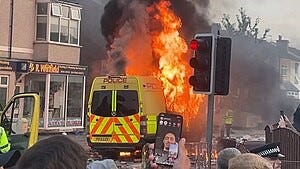
The recent riots in the UK, during the early days of August, were just such an occasion, when the mask slipped and exposed that thin veneer of civilisation, a situation that can arise not only in this country but in many nations, when anger takes hold and people forget themselves.
It is rightly said that sometimes we are a few square meals away from anarchy, and events around the world regularly show how decent values can be fragile in the face of shortages or provocations. I tried looking for a source quotation on this oft-repeated saying about square meals, and found the two above variations on the theme at the top of this article.
Society matters
Sadly we can’t blame the lack of three square meals for the absolutely appalling behaviour seen over six days in August in the UK this year. We may have foodbanks, one of the few growth sectors in the country, but few people are going hungry. For sure, times are hard for some people, after a couple of decades of austerity, and a generation impacted by failed neo-liberal economics, the asset stripping of public services, and the attempts by some to deny the existence of society, epitomised by the remark by former Prime Minister Margaret Thatcher that:
“There is no such thing as society”,
a falsehood if ever there was one. She may have crushed the unions, but social bonds are the glue that binds us together, the shared values, the recognition that, to quote the words of the late MP Jo Cox, who was murdered by a Far Right extremist:
'We Are Far More United Than The Things That Divide Us'.
A privileged nation
For sure, there has been a cost-of-living crisis, and some people have struggled badly with fuel bills. There is rampant social inequality, with some towns, cities and regions badly left behind, a situation that Brexit will only exacerbate rather than resolve.
However, the UK as a whole remains as a whole an immensely privileged society, and whether rich or poor, we all benefit from a National Health Service (NHS) free at the point of need, that many other nations can only dream of, free education up to college level, a welfare state, an enviable road and rail network, and the many benefits we have, often paid for by our exploitation of colonies and history of empire. We may sometimes forget just how fortunate we are. Not without reason did Cecil Rhodes say that:
"To be born English is to win first prize in the lottery of life"
Mob rule
Yet in the recent riots, mobs of Far Right thugs took to the streets, drawing in onlookers, the hard of thinking and the easily led, mobs whipped up by facile slogans such as “Stop The Boats”, a right-wing press that demonises foreigners, and social media that has replaced reliable news sources for a worrying segment of the population.
Mosques and asylum hostels were attacked, with one set on fire. Foreign-looking people were attacked. Shops were looted. In one town a checkpoint for cars was set up and almost unbelievably occupants were quizzed on whether they were “white and British”. There was arson involving cars, police vans, a Citizens Advice Centre and a library/food bank. Absolutely appalling behaviour. An attempt at mob rule reminiscent of Kristallnacht but on a smaller scale.
Thankfully the police and courts mobilised quickly. This week saw a court hand out the longest prison sentence so far, of nine years, to one rioter who attacked police and helped others set fire to a hostel.
What on earth were the rioters thinking? The poor hotel staff cowered in a safe room, barricaded in with fridges and freezers, and fearing for their lives just for doing their jobs. Rioters looking up from outside at people locked in their rooms, and drew fingers across their throats, gesturing to asylum seekers hiding in their rooms. Police defending the hotel were hospitalised. This was not some medieval mob, or some Eastern European pogrom from the early 20th century, but the UK in 2024.
Learning lessons
What does this say about human nature, and about how little we have progressed for all our pretence of social advances?
This article considers some of the possible causes of the riots:
This is my own attempt at analysing some of the possible causes:
https://medium.com/bouncin-and-behavin-blogs/riot-britannia-97dd235c6e7b
The 2024 riots in the UK were the worst since 2011 (when a police shooting of a suspect started a similar violent outbreak of looting and disorder). Hopefully as things settle down, with the arrival of cooler weather, calm will be fully restored, and as a society we can learn lessons.
Further reading:
https://medium.com/bouncin-and-behavin-blogs/riot-britannia-97dd235c6e7b
https://medium.com/@johnpearce650/the-accidental-activist-645565f7c2bd
https://www.bbc.co.uk/news/articles/cgedwp08dwdo
https://en.wikipedia.org/wiki/Kristallnacht
Article about the far right -
https://www.bbc.co.uk/news/articles/c74lwnxxxzjo
Article about possible causes
https://en.wikipedia.org/wiki/2024_United_Kingdom_riots